

MAIN STREET AMERICA
COLLABORATION
Camp Bowie District, Inc. is a member-funded nonprofit dedicated to strengthening Camp Bowie Boulevard and its surrounding streets. Through collaboration with local businesses, the organization supports promotion, community engagement, and ongoing improvements — helping maintain the corridor as a key destination for shopping, dining, and everyday life in West Fort Worth.
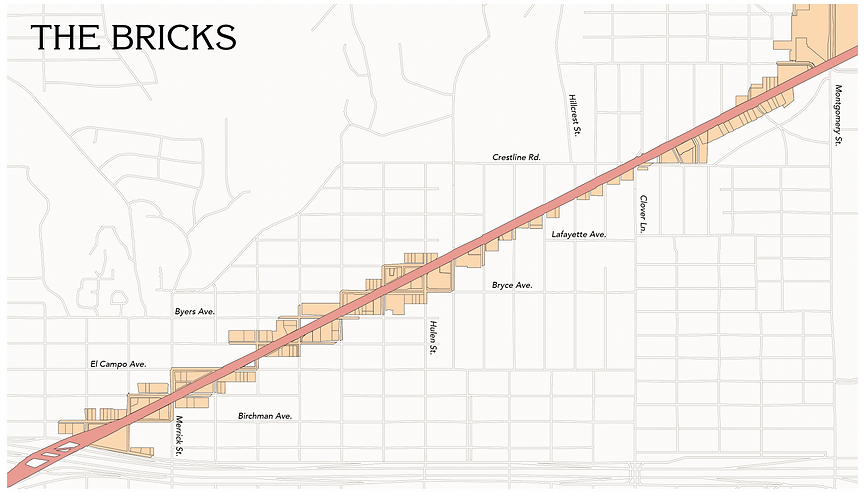
In 2025, Camp Bowie District Inc collaborated with Main Street America to analyze the Bricks subdistrict of Camp Bowie Boulevard between Montgomery St and Interstate 30. With input from residents, businesses, property owners and other community stakeholders, CBDI and Main Street America broke down the fundamentals of the existing boulevard and put together data that has turned into an extensive strategy to move Camp Bowie District forward.


KEY VISITOR DATA
The following data is based on the 2024 anonymized mobile location data aggregated by Placer.ai.
1.9 Million total visits to The Bricks in 2024

280,000
Local visitors
635,000
Non-Local visitors
Approx. 7:1 non-local to local visitation ratio.
INSIGHTS
The average visit lasts about 49 minutes.

Visitors return frequently, averaging about 5 visits per person.

21,800 residents living within one mile of the corridor generated approximately 280,000 visits.

Restaurants remain a major draw to Camp Bowie District, reflecting the corridor's place within the broader Fort Worth dining scene.
• 7% of visitors dine elsewhere before
visiting the corridor.
• 8% of visitors dine elsewhere after
visiting the corridor.

1.9 million total visits to Camp Bowie Blvd in 2024 — a 5% increase year over year.


DATA EVALUATION


Strong participation in the process:
Stakeholders, including business owners and community members, were actively engaged throughout the study, providing meaningful input.
District length:
The corridor’s extended footprint creates both opportunities and challenges in maintaining a cohesive identity and experience
14% residential frontage:
A limited residential presence along the corridor impacts consistent foot traffic and neighborhood integration.
Unclear brand identity (“The Bricks”):
While the “Bricks” name exists, it lacks widespread recognition and a clearly defined identity among visitors and stakeholders.
Ongoing neighborhood engagement is essential:
Continued input and involvement from surrounding neighborhoods will be critical to long-term success.
Visitors “look like residents”
Customers blend seamlessly with nearby residents, reinforcing the district’s neighborhood feel.
Unique angular nodes:
Irregular intersections and angles create a distinct character, but can present design and navigation challenges.
Proximity to downtown:
The district is located approximately a 10-minute drive from downtown Fort Worth via I-30, offering strong geographic accessibility.
Mixed quality developments:
Variability in property conditions and design impacts the overall visual cohesion of the corridor.
Commitment to “Uniquely Fort Worth”:
There is a shared desire to preserve and highlight the district’s local character rather than adopt generic development patterns.
Entrepreneurs are growing and moving to the Bricks:
Emerging businesses are increasingly choosing the district as a place to establish and expand.
Parking is a recurring theme that must be addressed:
Parking availability, access, and perception remain consistent concerns among stakeholders.
THE STRATEGIES
The Main Street America approach defines strategies derived from a solid understanding of local and regional market data and sustained and inclusive community engagement. Through these interactions, we can develop strategies based on two basic approaches bolstered by survey responses, community demographics, and visitor psychographics that all help to identify potential consumer groups that are most appropriate for the community.

CONSUMER - BASED STRATEGY
Consumer-based strategies focus on a definable group that has capacity but unmet needs. Consumer strategies include workers, residents, college students, tourists, military installations, family-friendly, millennials, and retirees/elder-friendly.
THE FOCUS
Neighborhood Residents:
Align the corridor improvements with resident preferences.
Tourists & Event-Goers:
Leverage busy event days to boost shopping, dining, and hotel stays.
THE STRATEGY
INCREASE RESIDENT
VISITATION
-
Holiday decorations on the boulevard
-
Tactical safety improvements to cross the boulevard
-
Business recruitment to support resident needs
-
Inclusion of neighborhood leaders in committees & board
THE METRICS:
-
Measure resident visitation
-
Track # of safety improvements
-
Track # of neighbor participants
-
Host focus group discussion to understand needs
BROAD RESIDENT ENGAGEMENT
-
Regular community engagement meetings
-
Empowered Main Street Committees
-
Participatory placemaking & public art projects
-
Resident-focused marketing & outreach
-
Regular surveys related to business improvement
THE METRICS:
-
Resident reach
-
Attendance of meetings
-
Resident committee participation
-
Placemaking projects completed & resident participation

PRODUCT - BASED STRATEGY
Product or experience-based strategies focus on the expansion of an existing cluster or cultivation of a new cluster. Product and experience-based strategies include the arts, entertainment/nightlife, sports and recreation, apparel, education, convenience, food, and others.
THE FOCUS
Locally-Grown Retail:
Support indie businesses — community pride and strong demand along the corridor.
Walkable Commercial Nodes:
Strengthen natural nodes through thoughtful, pedestrian-friendly redevelopment.
THE STRATEGY
PLACEMAKING AT KEY
DISTRICT NODES
-
Parking management & unified
agreements
-
Branding of nodes
-
Node-specific events
-
Pop-ups
-
Community Events
-
-
Pedestrian safety projects
THE METRICS:
-
Track pedestrian safety improvements
-
Visible branding efforts
-
Event Activations
-
Placemaking projects completed
CODIFY DEVELOPMENT APPROACH
-
Pilot node community design charrettes
-
Support for historic preservation tax credits & redevelopment financing
-
Celebrate Camp Bowie's progress of resident-supported redevelopment
THE METRICS:
-
Property investment based on community input
-
City Council adoption of policies that improve predictability
-
Reach & impressions of content related to Camp Bowie's work
THE STUDY
This study, conducted in partnership with Main Street America, provides a data-driven roadmap for strengthening Camp Bowie’s historic “Bricks” corridor while preserving its character. Grounded in national best practices and local market insights, the plan aligns community input, consumer behavior, and economic strategy to support locally owned businesses and guide future growth. As Camp Bowie District Inc puts these findings into action, the study serves as a foundation for a sustained renaissance rooted in place, identity, and long-term vitality.


ABOUT MAIN STREET AMERICA
Main Street America is a national nonprofit that helps communities strengthen historic commercial districts through preservation-based economic development. Its proven model, the Main Street Approach™, was used in partnership with Camp Bowie District, Inc. to guide the corridor’s future. The approach focuses on four key areas: economic vitality, design, promotion, and organization. It combines data, community input, and targeted strategies to support local businesses, improve infrastructure, and enhance the overall experience while preserving The District’s historic character.